Coding Is No Longer the Bottleneck
Shipping software used to feel like typing quickly enough to stay ahead of the compiler. You spent hours on boilerplate, wiring up dependency injection, configuring build pipelines, and arguing over where to put a constants file. The act of writing code was the constraint, so improving your keystrokes mattered.
That constraint has loosened. AI coding assistants generate entire features in a single sitting. Mature frameworks absorb cross-cutting concerns. Managed infrastructure removes the need to provision servers before you can deploy. Yet many engineering teams are not shipping ten times faster. A pull request that takes twenty minutes to generate can still take four days to reach production, or it can reach production and break something subtle that no one noticed until an alert fires.
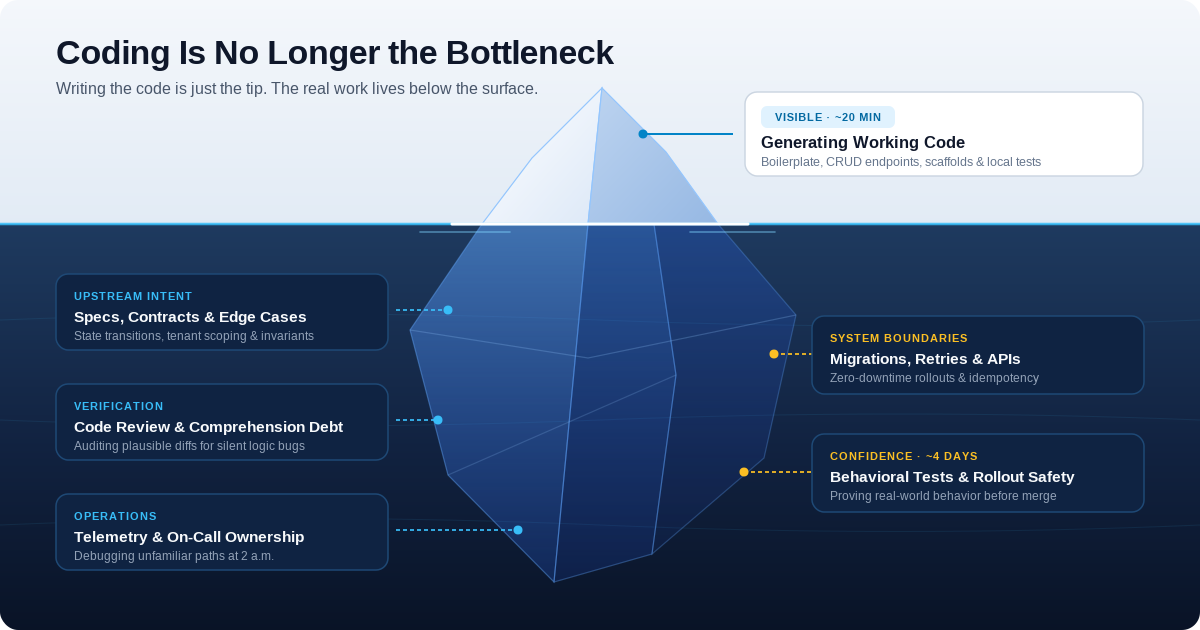
The bottleneck did not disappear. It moved upstream and downstream of the editor.
The Illusion of Speed
Consider a common scenario. A product manager wants a new endpoint that exports a user’s activity history as CSV. An engineer prompts an AI coding tool, and within twenty minutes the tool has produced the controller, the service layer, the database query, a serializer, a unit test file, and a README snippet. The code compiles. The tests pass locally. The diff looks clean.
Then the shipping work begins. The database migration needs a backfill strategy for existing users. The export needs to respect data-retention policies that the generated query ignores. The authentication middleware must scope the request to the correct organization, which the generated code assumes but does not enforce. The downstream analytics service expects a specific timestamp format, and the CSV serializer emits ISO strings instead. Someone has to write a feature-flag rollout, update the runbook, and add a dashboard so on-call knows if the job fails.
Four days later, the PR merges. Or, worse, it merges without those steps, and the endpoint returns a 500 under a specific combination of query parameters that the generated tests never covered.
Faster keystrokes do not compress coordination, review, or operational risk. They compress one narrow activity: turning intent into syntactically valid code. When that activity was the slowest part of the pipeline, optimizing it made a difference. Now that it is cheap, the rest of the pipeline dominates cycle time, and generating code faster can actually increase the load on every downstream stage.
Where the Bottlenecks Actually Moved
Problem definition and ambiguity
AI tools are strong at producing code from a description, but they cannot decide what the description should be. The hard work is specifying edge cases, state transitions, and product intent before a single line is generated.
Take an order lifecycle. An engineer can ask a model to write an Order state machine, and it will emit a clean switch statement with pending, paid, shipped, and cancelled. What the model does not know is whether a payment webhook can arrive after an order is cancelled, whether a refund should reopen the order, or what happens when inventory is reserved but the payment fails three days later. Those are product decisions buried in edge-case logic. If they are not settled upfront, the generated code will make assumptions silently, and those assumptions surface as production bugs weeks after the PR is merged.
Here is what brittle generated code often looks like:
// Brittle generated code
export function transition(order: Order, event: Event): Order {
  if (event.type === 'paid') {
    return { ...order, status: 'paid' };
  }
  return order;
}
It handles the happy path but says nothing about invalid transitions. A contract would look more like this:
pending --paid--> paid
paid --shipped--> shipped
cancelled --(terminal)--> cancelled
Specifying intent is also where types and contracts matter most. A generated function might accept a userId parameter and return a User object, but it cannot tell you whether userId is an internal UUID, an external email hash, or something that changes when a user merges accounts. The engineer must define those boundaries in writing or in type definitions before generating the implementation. Otherwise, the code is fast to write and slow to correct.
Code review and comprehension debt
Reviewing code you did not write is harder than reviewing code you did. This creates an asymmetry that AI amplifies. A model can generate eight hundred lines of plausible-looking code in under a minute. A reviewer might need an hour just to understand what those lines are doing, and another hour to verify that they do the right thing.
Plausibility is the trap. Generated code often uses idiomatic variable names, follows conventional file structure, and passes the linter. It can contain a subtle logical error—a date range that is inclusive on one side and exclusive on the other, a database transaction that commits before a side effect is flushed, an HTTP error handler that swallows the wrong exception class. These errors do not fail the build. They fail in production under specific load patterns or data shapes.
Reviewers also face fatigue. When a PR is large and mechanically generated, the temptation is to rubber-stamp it because it looks correct and the CI is green. That shifts risk from the author to the reviewer, and from the reviewer to the on-call engineer who will debug the incident three months later. Verification effort now scales with generation speed, and that is a losing trade if the review process does not change.
Architecture, integration, and system boundaries
Local code generation works within a file or a repository. It does not naturally see the data model in production, the migration history, the third-party API rate limits, or the failure modes of a distributed system. Those are the boundaries where real engineering happens.
Adding a field to a table is trivial to generate. Managing the migration without locking the table, backfilling existing rows, and keeping the old version of the service readable during a rolling deploy is not. Calling a third-party payments API is a few lines of generated code. Handling idempotency keys, retries with jitter, partial failures, and webhook signature verification is an integration problem that spans services and teams.
Generated code also tends to optimize for the local happy path. It rarely captures circuit breakers, bulkheads, or graceful degradation unless explicitly prompted, and even then the engineer must know where to place those boundaries in the architecture. If the service is part of a distributed system, the code’s correctness depends on contracts with other services, message schemas, and eventual consistency guarantees, none of which are visible inside a single editor tab.
Testing, observability, and operational ownership
Knowing what to test is harder than writing tests. Generated test suites often assert implementation details rather than behavior. They mock the dependencies that the developer chose, which means they validate that the code matches itself, not that it matches reality. A test can pass while the endpoint returns the wrong HTTP status code for a specific client, or while a background job silently drops messages under load.
Observability follows the same pattern. The generated code may log, but it may not log the correlation ID, the tenant ID, or the duration that matters during an incident. When production breaks in an unfamiliar code path, the engineer on call has to debug code they did not write, with tests they did not design, and metrics that were never defined. Mean time to recovery depends on system familiarity, not on how quickly the code was generated.
Operational ownership extends over years, not days. A feature that ships quickly but cannot be understood, modified, or retired safely becomes technical debt. When the original author is effectively a model, the responsibility for long-term maintenance still sits with the team. The code is cheap to generate; the lifetime cost of running it is not.
Where Coding Still Is the Bottleneck (Nuance Check)
None of this means coding is never the hard part. There are domains where the implementation itself remains the constraint.
Novel algorithms, such as a new compression scheme or a cryptographic protocol, require deep reasoning that current tools cannot reliably automate. Tight performance or systems work, memory layout, lock-free structures, and kernel bypass, demands control over the machine that abstracted frameworks and generated code obscure. Deep legacy refactoring in an untyped, untested codebase with unknown dependencies is often more archaeology than generation; the model cannot see what it cannot read. Subtle concurrency bugs, where correctness depends on memory models and lock ordering across threads, are cases where writing the code is only the beginning, and proving it correct is the real work.
In these areas, coding is still the bottleneck, and treating generated output as a first-class solution will produce subtle failures. The point is not that code no longer matters. It is that for the majority of application development like CRUD APIs, dashboards, integrations, internal tooling, etc; the code is no longer the limiting factor.
How Engineering Workflows Should Adapt
If implementation is cheap, the workflow should optimize for clarity, verification, and operational safety rather than for generation speed. Here are a few shifts that teams can make without adopting a new toolstack.
First, ship smaller pull requests. A two-hundred-line diff is easier to review than an eight-hundred-line generated feature. Stacked changes let reviewers focus on one boundary at a time, and they reduce the blast radius when a generated assumption turns out to be wrong. Small PRs also force the team to decompose the problem into testable pieces, which surfaces ambiguity early.
Second, invest more time upfront in specifications, types, and contracts. Define API contracts before generating handlers. Model state transitions as explicit diagrams or tables rather than letting them emerge from generated if blocks. Use type systems to encode invariants that tests alone cannot catch. The time spent writing a good specification is time saved in review and production debugging later.
Third, automate verification gates and treat them as non-negotiable. Type checks, linting, contract tests, and property-based tests should run on every generated change. The goal is not to prove the code is perfect; it is to catch the classes of errors that generated code is prone to, for example, off-by-one errors, missing null checks, mismatched payload shapes, etc, before a human reviewer spends time on them.
Fourth, change how code reviews are conducted. Review the specification and the diff together. Ask what the code does not handle, not just what it does. Require reviewers to identify at least one failure mode for each PR, and require authors to explain how the system behaves when a dependency is slow or unavailable. If a PR is too large to review meaningfully, split it before reviewing it.
Fifth, treat generated code as untrusted until proven otherwise. Run it through static analysis, write independent tests that assert behavior rather than implementation, and exercise it in a staging environment that resembles production. Do not merge a PR because the AI says it works or because CI passes. Merge it because the team understands it and can support it.
Finally, pair shipping with ownership. The engineer who deploys the code should be the engineer who responds when it breaks. That creates a feedback loop where generated code is only accepted if the person maintaining it can actually debug it. Ownership is the cheapest form of quality control.
Conclusion
When writing code was expensive, engineering value was measured partly by how fast and accurately someone could translate a requirement into a working program. That skill still matters, but it is no longer the scarcest resource on most teams. The constraint has moved to deciding what to build, verifying that it behaves correctly across boundaries, and operating it safely over time.
The teams that ship faster in this environment are not the ones that generate the most code. They are the ones that understand their systems well enough to know when generated code is safe to deploy, and when it is not. Implementation is cheap now. Judgment is what remains expensive.
If you’re trying to put some of those guardrails into practice: pushing AI tools to clarify requirements, respect architectural boundaries, and verify edge cases instead of blindly dumping code. I’ve been collecting reusable prompts and workflow skills in ai-engineering-skills. It’s open source, and built around treating AI output as something to specify and verify rather than rubber-stamp.